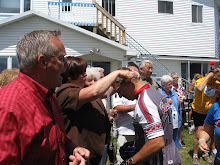
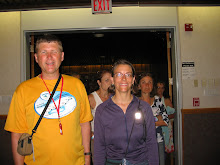
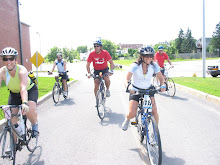
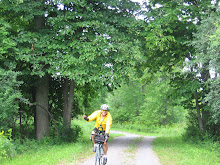
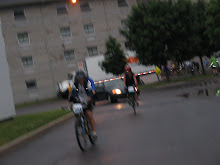
I can’t say that I miss getting up and riding 100 k every day but there’s one thing I do miss – the sense of connection this great effort engendered, connection to other people, to the land, to the lake.
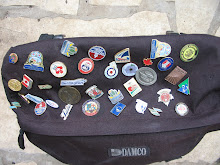
We travelled a long way through very disparate communities but everywhere received a wonderful welcome from people with a genuine appreciation for what we were doing. We were a disparate bunch of riders, ranging in age from 10 to 76, with six over the age of 70, and 14 under 18. A total of 148 completed the end-to-end and received the weighty zinc medallions bearing the bird, leaf, fish symbol of the waterfront trail.
Most of us were from Ontario, 8 came from elsewhere in Canada (4 from Alberta) and 9 from the US (5 from Texas). Toronto sent the most people with 19 and Ajax sent 12, including their mayor. For the most part we were of European heritage, but there was a fast-paced contingent of Chinese Canadians. Based on the form people filled out before the tour, 40 per cent enrolled as single participants, the rest joining as family groups or groups of friends.We all became friends along the way. Before the tour ended, some pondered what the trip had meant to them.
Antonio Siracusa, bank teller, Toronto: “I have found it an amazing experience. I have learned a lot about the communities around me. I have learned more about myself as a person and more about people in general. From a spiritual perspective, you start somewhere such as Niagara on the Lake and you end up in Quebec,- what happens in the middle is what the journey’s all about. From a responsible taking-care-of- yourself physical point of view you get tons of exercise. It’s nice to meet like-minded people who are pro-environment. I’ve learned that I can ride in the rain and that’s the first time I’ve ridden in a small storm like that. As I got going it was easier to do and I just found it fun. So I won’t be scared to ride in the rain any more. I’ve learned that I can push myself to a limit and give myself a little pep talk and keep going keep going and find another limit.”
Ian Cheah, guide:“It was a great, great adventure, because I’ve seen a lot of Canada I don’t see normally. I had two little kids in my group, they did it, they started on the longest day, 130 k, and went through to the end. For me, the main thing was endurance. Speedwise, it’s ok, no hills. So each day, over 100 kilometres, I wanted to challenge myself for eight days, no rest, just hard work. It’s a challenge that I achieved, I feel good. I’m hoping to go to South America. That’s what this test is all about.”
Marie-Claude Caplette, teacher, Toronto:“I enjoyed it very much – the scenery, the flowers, the beauty of the nature, the life and particularly, the villages along the lake which I had had no occasion to see. I’m feeling very good, each day I feel better, I don’t know why because I don’t regularly exercise but right now I’m feeling in very good shape. Each day, I just try to take it easy - a lot of stretching and trying to breathe, yoga has been helping me, so I just enjoy, and try not too much to follow the group in front. Pace yourself – follow your own rhythm.”
Geoff Kettel, consultant, Toronto (speaking at the Cornwall dinner):“We need to encourage our cities and towns and villages to get better trails. To separate the trail from the road, or to mark the trail with a white line. And we can go home to our cities and ask our councillors to make cycling and safe cycling an important thing for all of us. Phone your councillor and show up at the meetings and ask them to acknowledge that cycling is growing – it’s doubled in the last three years – more people want to cycle but they want to cycle safe. So it’s very important that we make them safe and that we do that by the trail.”
Brenda Mills, mental health specialist, Hamilton:“I think it exceeded my expectations for sure because I think that I came expecting to cycle and have an experience of seeing new places but it’s so much more about just having the experience to share with other people and then having the opportunity to do it for the first time and I think an appreciation for all the work that went into to and just seeing this is something that is possible. If you really want to make it happen, it’s really about people coming together and having a common interest. I think the common goal was to really promote community - community as in our cycling community, community as in the communities that the waterfront trail is in. And a sense of ownership into that community so that if everybody has those kinds of ideas and if they come together with those goals in mind it will have support, it will have momentum.”
With that in mind, the next lake event takes place next Tuesday at 6 p.m. in Kingston. It’s a mass swim at Richardson Park, where there’s a beach that has fallen into disuse through lack of civic maintenance. The event is aimed at building support for public water and public space in that city – exactly what our ride was about. Enjoy your swim, everyone!
Showing posts with label cycling diary. Show all posts
Showing posts with label cycling diary. Show all posts
Friday, July 18, 2008

Friday, July 11, 2008
Day 8 Cornwall to Riviere Beaudette
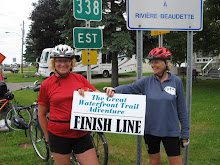
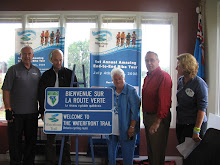
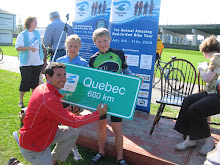
We made it! And we have the medals to prove it, handed out at a ceremony at Chez Bob, an eatery just over the Quebec border. The first Great Waterfront Trail Adventure has come to an end and the cyclists are dispersing to heal and meet the next challenge.
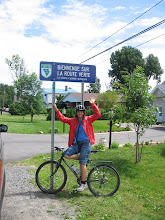
Day 8 began with a breakfast announcement of new signs and a kiosk to be placed at the Ontario-Quebec border, officially marking the juncture of the Waterfront Trail and the Route Verte. We left Cornwall under cloudy skies, an earlier drizzle of rain having ended. It was cool but pleasant as we headed out on what we were told would be a 31-k ride to Riviere Beaudette at the border.
It's not a trip I'd particularly recommend, being boring and bumpy, much of it parallelling Highwy 401. Unless, like us, you want to be able to say you went from border to border, or, much better, unless you're headed for Montreal - there's a wonderful stretch of trail leading to that city.
Anyhow, according to some bicyle computers, the distance was 48 k. And on the bus back from the border to Cornwll, cyclists compared notes and did some recalculations, concluding that the real distance covered since Niagara-on-the-Lake is 770 kilometres, not the 680 we've been led to believe. In fact, many expressed the suspicion that we've been consistently given under-estimates of the distance we were going to cover each day, in order to spur us to ever greater effort. Hmmm. I can't say, not having any technical equipment, but I promise to get to the bottom of this with the folks from the Waterfront Regeneration Trust, and will advise.
As you can infer, this won't be my last diary entry. I interviewed several people on their thoughts about the experience and will be posting that in a day or so. And I think I shall follow up on a couple of other issues that have arisen en route, such as the situation with the Murray Canal roadway, and is a big chunk really going to be taken out of Oshawa's waterfront for an ethanol plant?
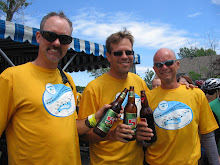
For now, a brief summary of the last 24 hours of our trip. There were some magical moments. After 7 days of grime and sweat, we were all pretty amazed to arrive at a dining room in the Cornwall arena on the evening of Day 7 to discover beautifully laid tables, clean linen, properly served food and the possibility of buying wine and beer to go with our lasagna dinner.
The evening was one of great camaraderie, and the Waterfront Regeneration Trust staff who have worked towards this event for several years - Marlaine Koehler, Vicki Barron, David Arcus and Petrina Tulissi - quite properly got the recognition they deserved. Heartfelt applause greeted tour director Ian Lobb who, with his band of yellow jersey volunteers, ran a thoroughly professional tour.
"It was awesome organization and awesome execution," cyclist Jim Best said to me. "You can have good organization but without good execution it just falls apart. They had both."
After dinner we headed over to the Cornwall balloon festival, for music, dancing and, apparently, balloon rides. Before that, Anna Biro and I had a heart-stopping moment. We'd left our bikes at the top of the stairs leading down to the arena's lower level where dinner was held, lashed together with bungee cords. Who would want these old things, we told each other. But when we came back, they were gone. And the previously empty building was teaming with people. We didn't panic. Much. We took our plight to security guard Pat Chartrand and - oh joy! - she revealed she'd moved the bikes to a safe place. Big hugs for Pat Chartrand!
We all had varying degrees of misfortune during this trip -some minor, some more serious. One with a fierce streak of bad luck was 14-year-old William Thomson, who had 7 flat tires (or was it 9?), brake failure (off to the nearest bike shop) and then finally a spill in the road construction area at Iroquois that resulted in a painfully sprained wrist curtailing his participation. Still, he was on hand for the last day and full of praise for the event. "I really enjoyed the ride," he said "It was good. Maybe I'll be luckier next year." And with that he was driven to Riviere Beaudette and mounted his bike to cross the line with the rest of us. That's the spirit, Will.
Thursday, July 10, 2008
Day 7 Johnstown to Cornwall
It's Ontario's best-kept secret - this wonderful stretch of waterfront trail along the St. Lawrence River. First, it's within sight of water almost all the way. Second, much of it is off-road, and the sections that are on County Roads 2 and 4, have a decent shoulder and feel safe. Third, east of Iroquois is completely flat, so the day is spent on a reasonably effortless cruise, actually enjoying the act of cycling rather than enduring it as a necessary adjunct to a pleasant way of seeing the world.
The gods of weather are with us again on Day 7, providing sun and cloud and a cooling breeze. My ankle still hurts so I stop off at the Iroquois pharmacy seeking sympathy and a professional opinion.The pharmacist doesn't even want to look at my ankle. Take Ibuprofen and do some stretching, he says. I wonder whether a bandage might be a good idea. (I rather fancy one as an ent-of-tour fashion accessory.) He looks dubious, so I back off. I decide not to mention the twinge in my knee. It's nothing, really.
I'm just delighted with the route and it gets better all day. We go off-road at Crysler Park and cycle into Upper Canada Village, created from buildings moved from 10 villages that were flooded in 1958 to allow construction of the St. Lawrence Seaway, which tamed a dangerous stretch of river and replaced a canal system that wasn't large enough to accommodate ocean-going vessels. It was a traumatic experience and one can still meet people who struggle with the emotional loss of community and family history that comes from the obliteration of a familiar landscape.
After lunch at the Harvest Barn, the trail takes us into the charming Upper Canada Migratory Bird Centre. The path goes through various types of forest, including some beautiful tall pines. There are people fishing off a causeway and several cyclists report seeing deer. There's an interpretive centre where shiny new bicycles had just been delivered - they're going to be available for rental.
The trail finally curves up to the road and I think I'm in for some highway riding, but no - it curves back into the Long Sault Parkway, a road that links 11 islands created by the flooding. Just a marvellous area for cycling. And when it comes to an end, no, it's not back onto the highway, there's a very nice separate bicycle path that runs parallel, weaving in and out of a pleasant naturalized area - nothing short of perfect. Here we are at the Lost Villages Museum, and cyclists are coming off the trail exclaiming at how beautiful the ride has been today.
And still it goes on. There's a great paved trail all the way into Cornwall. I find myself on a long stretch with a canal on one side, the river on the other at a much lower level - which feels really strange. I'm riding alone and I go for so long that I worry I may have missed Cornwall.
I stop to ask a solitary cyclist = not part of our group = standing with his bike watching the demolition of a factory on the other side of the canal. I'm on the right track, Cornwall resident Don Bowman tells me. "What's that?" I ask, pointing at the factory. "Domtar," he says, "I worked there almost 30 years." This used to be the largest paper mill in the world, he adds. He's 51, retired on full pension. The factory may be replaced by condos. "It's sad," he says.
And then I ride on into Cornwall - which has an incredible stretch of waterfront trail. How did that happen? And why can't everyone do it?
Wednesday, July 9, 2008
Day 6 Kingston to Johnstown
It's true. Tour director Ian Lobb said that Day 6 would be better and that's what happened. This morning, it didn't take 15 k for my legs to kick into gear. My bicycle flew like a gazelle and I had difficulty holding it back.
However I have now moved into the ranks of persons with a sports injury. I don't think that has ever happened to me before. I did break my leg skiing when I was a kid but they didn't have sports injuries in those days - it was just a broken leg. My ankle started acting up on Day 4, and by Day 5 I mentioned to a couple of people that it felt like my tendon was strained. I thought it might need to be wrapped. They didn't seem very worried. One suggested ice, the other that I drink lots of water. So I just powered through it. It's nothing, really.
For the first time I was able to say 'Coming up on your left,' to a couple of people. (That's cycling etiquette for passing.) One of them, unfortunately, had a real injury. Jim Best of Ottawa had a twisted knee from a soccer game with his granddaughter that he then aggravated in a fall on Day 3. That hasn't stopped him from completing the full route every day (unlike me). And speeding up to pass me after I passed him. "It's starting to get sore," he said later. "I'll get through."
One of the great things about Day 6 was the rain. We all thought that a kindly deity was watching out for us when it chose to rain on the night we weren't camping. We stayed in St. Lawrence College in Kingston and revelled in the joy of a bed and a shower after four nights camping. Then it seemed to let up. But as we breakfasted and listened to speeches from Kingston dignitaries (big cheers for Councillor Vicki Schmolka, one of us), it started to pour. We set out to the sound of gently squeaking brakes, guided single file through town by members of the Kingston Cycling Club, and it just got worse. It didn't matter. It was an an immense relief after five burning hot days.
After a long 5-k climb past Fort Henry, the route resolves itself into a steady slog along Higway 3. It dips in and out of view of the lake and offers long moments for reflection on the roadkill that litters the side of the road - goldfinches, squirrels, snakes, flattened out of recognition but for the flutter of a bright feather, the sheen of a bushy tail, the intricate pattern on smooth skin.
Some of us have signed up for a kayaking break with 1000 Islands Kayaking Company of Gananoque. We're so wet it makes absolute sense to go on the water. We learn some basic strokes and we're off, across the St. Lawrence, examining a sunken ship and weaving through the islands. A bonus is that we get shuttled 30 k or so to lunch, repressing mild guilt as the van whizzes past our fellowe cyclists straining at the pedals. Then it's on to Brockville, an attractive town where churches and some of the grander houses are roofed in intricate patterns of slate in two shades of grey and one of red. Time for a quick unveiling of a plaque to mark the achievements on the trail so far and it's back on the road, which seems a whole lot busier.
And so we roll into the Township of Edwardsburgh/Cardinal, where the local council has laid on a lavish reception, complete with free dinner and breakfast, a town crier and a tour of the Prescott grain elevator, an impressive facility built in 1929-30. The port of Prescott is a deep-water harbour that was purchased by the municipality from the federal government for $60 in 2000 and now is the outlets for grain grown in Eastern Ontario, yielding a million dollars a year in profit.
Like an army, a bicycle tour moves on its stomach. The sight of the chicken pieces lined up on the long charcoal barbecue pit operated by Richard Woodland, owner of Woodland Barbecue, was only surpassed by the taste, or so I'm told, being a vegetarian. "Put the chicken recipe on the website," one enthusiastic cyclist urged. "It's a secret," Councillor Hugh Cameron replied.
Cameron emceed an entertaining show involving members of the audience at Johnstown Grenville Park, where we're camping, and feelings of good fellowship abounded, prompting a standing ovation for Cameron, Mayor Larry Dishaw and Councillor Pat Bayeau - folks who clearly enjoy a good time.
Should I tell you how I appear to have mislaid my tent pegs and poles? No, it would make me look too silly. Anyhow, the tour has a spare tent - of course, they have a spare everything - which is five times the size of mine, so it has all worked out for the best.
Tuesday, July 8, 2008
Days 4 and 5 Darlington to Presqu'ile to Kingston
What is it with Parks Canada? Here we are, 170-odd cyclists heading into Prince Edward Country and we can't travel along the Murray Canal, one of the prettiest pieces of waterfront on the lake.
Instead we have to take a longer route to Carrying Place, along County Road 64, which is hot, busy, doesn't have a good shoulder and is a long way from the water.
The reason being that the federal government owns the Murray Canal. I've ridden the roadway that runs along it twice, and it's been allowed to deteriorate so badly it has potholes you can lose your bike in.
Marlaine Koehler, executive director of the Waterfront Regeneration Trust and organizer of the Great Waterfront Trail Adventure, says she tried to get in touch with someone at Parks Canada who had authority over this stretch of trail. She failed dismally. And Marlaine isn't the type to be easily derailed; it takes a very determined bureaucracy.
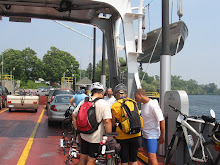
"I spent months trying to find the right contact that takes care of the Murray Canal so that we could get it in shape in time for this," she said as we waited in line at the Glenora ferry. "I couldn't find the one person. I couldn't find the guy who could tell me yes, we can, or no, we can't and this is why. As late as last night I took my car out to see if by some miracle it was okay, and it wasn't. It was very disappointing."
So the Murray Canal - one of 40 priority projects Koehler has listed that are needed to complete the missing links in the Lake Ontario Waterfront Trail - prompted a last-minute change to our itinerary on Day 5. The public owns this lovely 5-kilometre stretch, edged by banks of honeysuckle and dogwood framing boats drifting lazily along the canal. We should be able to use it.
Well, we've had two very long days. I threw in the towel at around 80 k on Day 3, completed the 120 k on Day 4 (which included the hills east of Port Hope, that somehow didn't seem as steep and deadly as they had six years ago) and called it a day at 110 k on Day 5, getting a shuttle ride for the last 20k from Bath to Kingston.
Tour director Ian Lobb says that in his experience Day 4 or 5 are the most difficult and by Day 6, a whole new cyclist hits the road. We shall see.
Pat Blackman, who hails from West Virginia, where the Potomac and the Shenandoah meet, reckons that Day 3 is the worst. Pat has the experience to speak with authority. An elegant figure with her grey hair pulled back in a pony tail, she'll be 70 this year and she runs Seniors Cycling (old folks on spokes) from her home town of Loudon Heights. When she read about the GWTA, she called Ian. "I asked, do you need a sweep?" A sweep is the person who brings up the rear and makes sure no stragglers get left out in the cold. She was in.
Every age is represented among this group of riders, making the event feel like a family gathering. There's Carl Janzen, 76, a retired salesman from Puslinch, Ontario, who rides 5,000 k a year, mostly in Europe.
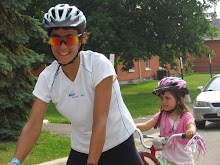
There's Jasper Heffernan-Wilker, who's two years old and rides on carrier seat behind his father Derek Heffernan, while sister Anna, 4, rides in tandem behind her mother Kathleen. The Ottawa family is out in force, with Derek's parents taking turns in riding the trail and driving support, and taking care of the children. Along for the ride are family friend Ron Arsenault (on a recumbent bike) with his son Zack, 13, from Fredericton.
Koehler says it can be a challenge attracting teenagers to cycling - they object to the clothes and the intensity - but there are quite a few on the GWTA. Just joining at the Presqu'ile Provincial Park campgrounds on Day 4 were Matthew McCarthey and his friend Alex MacPherson, both 13, both from Scarborough, who were supposed to ride just one day, but who put pressure on Matthew's mother Donna and friend Anna Sonderskov (along with daughter Katie, 10) to stay on the trip to the end. "Go for it,"Anna said. "It's going to kill us," said Donna, beaming from her bike.
Food has been an issue. Firstly, the vegetarian option appears to disappear east of Ajax, leaving some of us to fall back on the nuts and dried fruit we bring along for such emergencies. Then, there have been some meals that seemed lacking in the value-for-money department. The $15 a service club was charging seemed a little steep for beef on a bun and three salads and I got turned down when I tried to negotiate a deal for just the salads.
For a waterfront tour, there's a crying need for more waterfront east of Oshawa ( Oshawa's waterfront deserves its own blog entry, I'll do that after the tour).
Scarborough has improved immensely, with the trail running through quiet streets and for the most part avoiding busy Kingston Rd. , and then a final wonderful beach and trail put in by the Toronto Region Conservation Authority at Port Union. There are new stretches in Pickering that are very enticing, and Ajax gets top marks for having a seamless waterfront right of way across the whole municipality since 2006.
But since then we've generally been separated from the lake by lakefront property owners and agriculture and we've been riding country roads, all well and good in their way - but time done on a road is hard time, while time on a trail or even a road shaded by trees is a different matter entirely. If municipalities and the Ontario transportation department start planting trees along their roads now, the next generation of cyclists will be grateful.
We managed to actually get into the lake at Presqu'ile. We probably could have on other days (although many Lake Ontario beaches are unsafe due to pollution) but we were just too tired. Kingston Councillor Vicki Schmolka and her partner Gavin Anderson joined us for a dip. There's a lot of algae there, but pockets of weed-free water if you look. It was heavenly. Vicki is one of two municipal councillors who are riding end-to-end. Ajax Mayor Steve Parrish is the other.
Sunday, July 6, 2008
Day 3 Fort York to Darlington
Turns out Darlington Provincial Park isn't wired. So I've been driven in to Oshawa to do a brief post. I gather facilities for getting online tomorrow at Presqu'ile are iffy too, so I can't promise a new blog for Day 4. Suffice it to say that we had another day of gorgeous weather and a long ride - 88 kilometres for those who did the whole thing. I wimped out, catching a ride on a support vehicle for the last 10 kilometres, and thus missing Second Marsh, that I would very much have liked visiting as it's a wonderful wetland area around the General Motors headquarters.
I also whizzed past Thickson Woods, one of my favourite spots, a piece of virgin forest in Whitby that's an extremely important migratory bird area. Its huge white pines date back to pre-settler times and were saved from being razed for condos by committed local naturalists who raised hundreds of thousands of dollars to purchase the land.
Most thoughtful gesture of the day: the team of massage practitioners that the City of Pickering had waiting for us at a rest stop. Thank you, thank you.
Tied for best food so far: breakfast at Fort York in the junior officers' mess; lunch in Ajax, catered by a local firm; lunch in Lincoln on Day 1 that I believe was prepared by a St. Catharines restaurant. Those were exceptional - the rest have been very good, thanks to all who cooked for us.
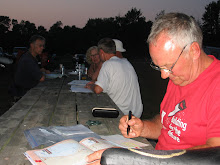
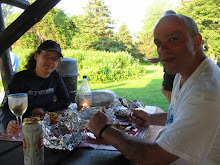
My personal favourite event of the day: Peter and Janet Stratis's 23rd anniversary dinner at a picnic table in the Darlington park. Wine, beer and an East Indian meal that had been dropped off in Ajax by their son and transported by a support vehicle to the park and heated in foil on a camp fire. There were candles and freshly picked flowers. And it appears it was no hardship to celebrate on the trail. "This is the best vacation," Peter said. "We've done all-inclusives, Greek island vacations, after three or four days I get bored. But you wake up in the morning, and you've got 100 k to go, there's no getting bored. And it's different every day. I love it."
Saturday, July 5, 2008
Day 2 Hamilton to Fort York
As the sun rose over the lake, we reached up to welcome it and then bent to contemplate the Earth. Day 2 of the Great Waterfront Trail Adventure started with a yoga session in Confederation Park, birds chirping from the sidelines, the scent of linden trees wafting through the air. We were tuning in to the mystic quality of the lake, a connection I feel every time I ride these shores.
David Crombie, the former mayor of Toronto who developed a vision for the waterfront in the 1990s, felt that people would be the best agent for environmental protection and regeneration. Build a trail, the people will come, and they will learn to love and nurture the lake. And that's what has happened. This is the most urban portion of the Lake Ontario Waterfront Trail, but it's the stretch where municipalities and conservation authorities are leading the way in developing a wilderness corridor that's an essential feature of life in a healthy city.
But first we had to get through Burlington. The city gets top marks for a sophisticated trail that brings the downtown to the lake and has tons of interesting features for young and old. But then it's on to the Lakeshore Rd., lined with palaces and chateaux that might make some degree of aesthetic sense nestled in acres of parkland, but are nothing short of ridiculous lined up cheek by jowl. In any event, there's no room for a bicycle lane on this street.
Before I leave Burlington, a big thank you to the municipality for a wonderful reception. They had a clever idea - we could fill out postcards (scenic views of Burlington) and they will mail them for us. It was a thoughtful and imaginative touch.
Oakville's a nice change of pace. Paved shoulders, and then down to the lake on to scenic Coronation Park. Mississauga is just as good - Lakeside Park has turned what was once an industrial wasteland into a place of curving trails along the edge of the lake, beautful views over the water in a lovely naturalized setting. And as we leave, I notice a really decent off-leash dog park where various species seem to be having a lot of fun.
I find that being part of a 170-person bike ride offers a lot more opportunity for solitary diversion than riding with half a dozen. A couple of us went our own way through Rattray Marsh, which wasn't on the official GWTA route because you're not allowed to ride a bicycle through this wild-life sanctuary. But I wasn't going to pass up a chance to visit one of the lake's magical places, so we walked our bikes through and enjoyed the peace and serenity of this provincially significant wetland that was saved in the 1960s, in an epic battle that pitted local community activists against a developer who planned to fill it in and build houses.
Out into Jack Darlington Park, one of the busiest on the waterfront - it was great to see so many people enjoying themselves by the water.
St. Lawrence Park in Port Credit is a very nice example of urban residential development that feels good - townhouses and apartment buildings that overlook a spacious section of trail with beautiful landscaping and a good lookout spot. I like Port Credit - a little further on, I forget exactly where - the trail runs past a pleasant cove with a nice sandy beach with a hedge of lots of different kinds of roses. The effect is quite wonderful.
We take another solitary moment on the tour, stopping at the Birds and Bees coffee shop on Lake Shore Rd. in Etobicoke for a top-notch cup of coffee that's virtuously fair trade, bird friendly, shade grown, organic - did I forget anything?
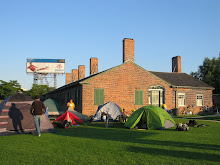
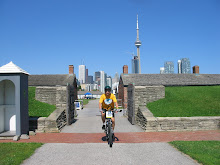
And into town through scenic Humber Bay Shores, past the crowds at Sunnyside and over to Fort York which is to be our camping spot for the night.
Friday, July 4, 2008
Day 1 - Niagara-on-the-Lake to Hamilton
It was a picture-perfect day, pleasantly sunny with a slight breeze off the lake, and an excellent start for the 170 riders on the first day of the first-ever Great Waterfront Trail Adventure. It bodes well for the bold vision of Marlaine Koehler, executive director at the Waterfront Regeneration Trust, who is behind this eight-day ride around the Canadian shores of Lake Ontario and down the St. Lawrence River to the Quebec border.
The inspiration comes from Iowa, where from small beginnings grew RAGBRAI, a 7-day cycling tour through a corn-dominated countryside that - no offence - can't compare to our Great Lakes. Now the Iowa event attracts thousands who vye to be one of the tour's 8,500 riders. In future years the GWTA may rival RAGBRAI which, in case you need to know, stands for the (DesMoines) Register's Annual Great Bicycle Ride Across Iowa.
For some, the pleasure of the first day on the trail was somewhat marred by mechanical failure aggravated by the fact that the riders had taken the precaution of having their bikes tuned up before they left.
Robert Thomson, who will be celebrating his 12th birthday on the trail on Sunday, had his bike tuned up by a bicycle store in Ajax. "It cost $200," said his mother Karen Vose. The cost included rebuilding the front wheel, which then gave out. Fortunately Adam Luffman of Liberty Bicycles of St. Catharines was running a free emergency clinic at Charles Daly Park in Lincoln, where the tour stopped for lunch. The tire on the "rebuilt" wheel wasn't new, he told Vose, in fact it was so worn that it needed to be replaced.
Karen Vose wasn't impressed. "They knew that I'm a newbie," she said of the store staff. When they told her of the extra work that had to be done, her attitude was "whatever they say." Luffman offered to drive back to St. Catharines to get a new tire but then it turned out that tour director Ian Lobb, had a couple of spare tires with him and Robert was able to get back in the saddle without delay.
I always take my bike for a tune-up before a long ride because it's an old clunker I got from K-Mart for $200 in 1995 and I don't trust my own skill in this regard. But I often suspect that the work that's been done hasn't made much difference - the brakes still squeak and the gears don't seem any smoother. My friend Anna Biro shelled out hard cash to make sure her bike was up to snuff and her front brake cable failed two hours out of Niagara on the Lake. Luffman was able to do a temporary fix. I asked him if he'd encountered any other people with botched tune-ups - turns out it was a familiar refrain. "Pretty much all day, that's the gist of it," he said.
As cycling grows in popularity, so do the numbers of people trying to take advantage. If you know of a good bicycle mechanic, spread the word. These are the people that need our support.
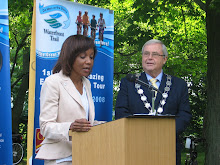
We got a great send-off from Niagara on the Lake, with assorted dignitaries, including Margarett Best, Ontario Minister of Health Promotion, who very pluckily got on a bike to ride a few kilometres despite not having done it for years. Ajax Mayor Steve Parrish, a keen cyclist, reminded us of the tragic deaths last week of two cyclists on the Manitoba stretch of the Trans-Canada Highway, where the lack of paved shoulders has been the source of complaints for years. Events like the GWTA can help us reclaim our roads from the automobile.
That said, Niagara Region could use more off-road trail. Although there has been improvement in the amount of paved shoulders, the Lake Ontario Waterfront Trail still has wearying stretches where there's no space set aside for cyclists and the lake is a distant notion. The amount of residential development that is taking place is dizzying. One longs for things to settle down a little in this beautiful part of the province. There's a need for more restful spaces, like the woods in Port Weller west of the Welland Canal, or Victoria Terrace in Grimsby Beach.
Monday, June 30, 2008
Countdown to Friday
I had to choose - the Tour de France or the Tour du Lac. It was hard but I decided on the Great Waterfront Trail Adventure. Although the Alps and the Pyrenees aren't too much of problem for me because I always do the Tour from the comfort of my living room couch. This time, instead of vicariously feeling the agony of the climb up the Col du Tourmalet, I'll be in my own endurance test on the peaks of Northumberland County, with only my newly purchased gel cushion to ease the pain.
I must admit to being the proud possessor of an end-to-end pin, proof of having cycled from Niagara-on-the-Lake to Gananoque, where the Lake Ontario Waterfront Trail ended at the time. I have done the "new" stretch, up to Riviere Beaudette. But I'm not a real cyclist - the kind that settles in, head down, to ride like the blazes for eight hours. Strictly recreational, way behind the peloton, that's me. Well-padded, not particularly fit and ready for any excuse to stop and taste the wine and smell the roses. I did my 700-odd kilometres in three-day stretches over a couple of years. So eight days in the saddle will be a new experience - a challenge that's being tackled by 170 people between the ages of 9 and 76. It's going to be exciting and difficult and a real adventure. Check in often as I make daily posts July 4-11. Log on to http://www.waterfronttrail.org/ for more information about the event.
See you in Niagara-on-the-Lake!
Subscribe to:
Posts (Atom)